2026 - Daylight Investigations - Evaporative Cooling Celosia
Category
Special Prize: Daylight Investigations - Evaporative Cooling Celosia - Western Europe
Students
Sophia Carmody
Teacher
Line Frederiksen
School
Royal Danish Academy
Country
Denmark
Download
Project ↓
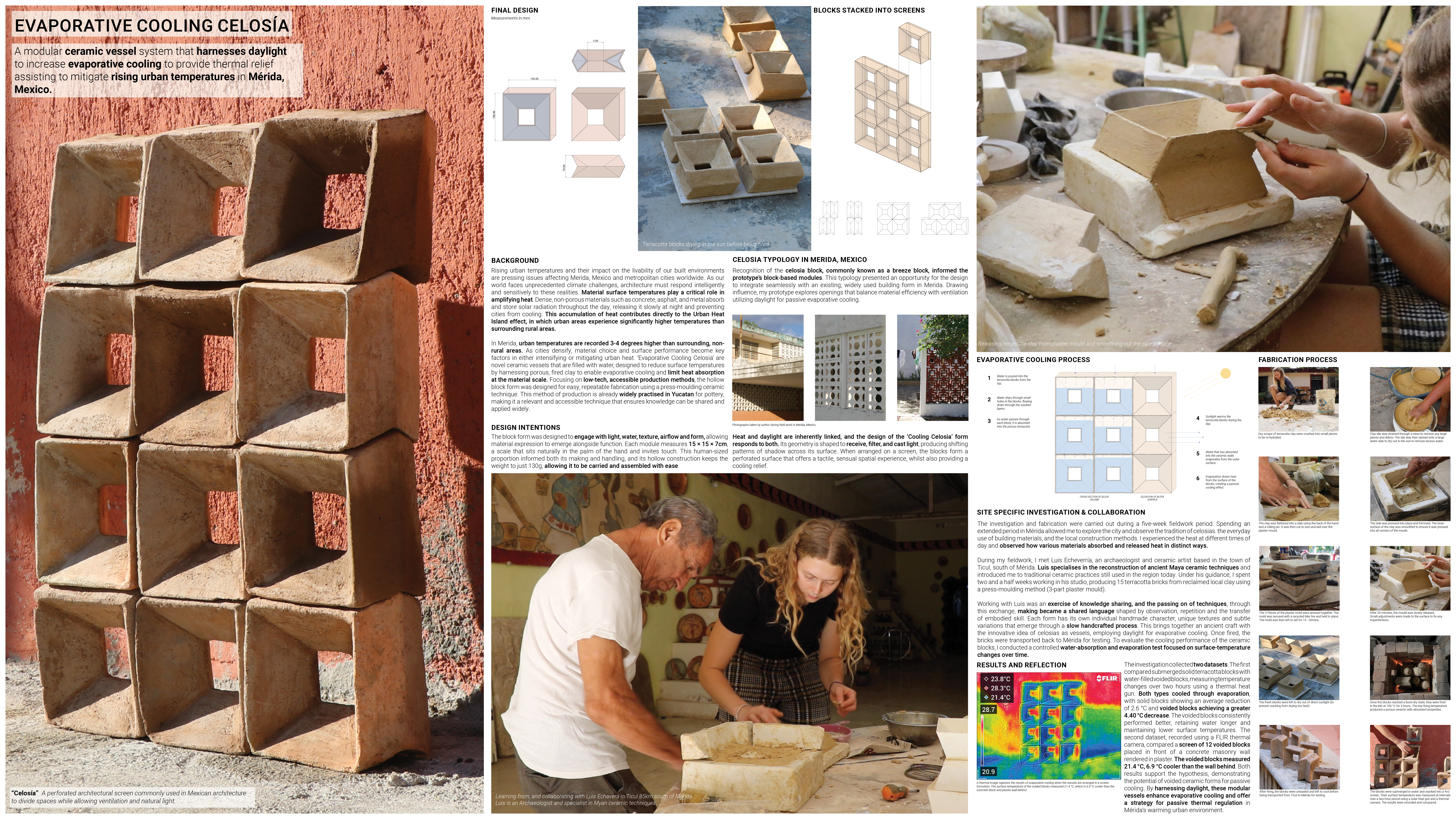
Evaporative Cooling Celosia Background Rising urban temperatures and their impact on the livability of our built environments are pressing issues affecting Merida, Mexico and metropolitan cities worldwide. As our world faces unprecedented climate challenges, architecture must respond intelligently and sensitively to these realities. Material surface temperatures play a critical role in amplifying heat. Dense, non-porous materials such as concrete, asphalt, and metal absorb and store solar radiation throughout the day, releasing it slowly at night and preventing cities from cooling. This accumulation of heat contributes directly to the Urban Heat Island effect, in which urban areas experience significantly higher temperatures than surrounding rural areas.
In Merida, urban temperatures are recorded 3-4 degrees higher than surrounding, non-rural areas. As cities densify, material choice and surface performance become key factors in either intensifying or mitigating urban heat. ‘Evaporative Cooling Celosia’ are novel ceramic vessels that are filled with water, designed to reduce surface temperatures by harnessing porous, fired clay to enable evaporative cooling and limit heat absorption at the material scale. Focusing on low-tech, accessible production methods, the hollow block form was designed for easy, repeatable fabrication using a press-moulding ceramic technique. This method of production is already widely practised in Yucatan for pottery, making it a relevant and accessible technique that ensures knowledge can be shared and applied widely. Design Intentions The block form was designed to engage with light, water, texture, airflow and form, allowing material expression to emerge alongside function. Each module measures 15 × 15 × 7cm, a scale that sits naturally in the palm of the hand and invites touch. This human-sized proportion informed both its making and handling, and its hollow construction keeps the weight to just 130g, allowing it to be carried and assembled with ease.
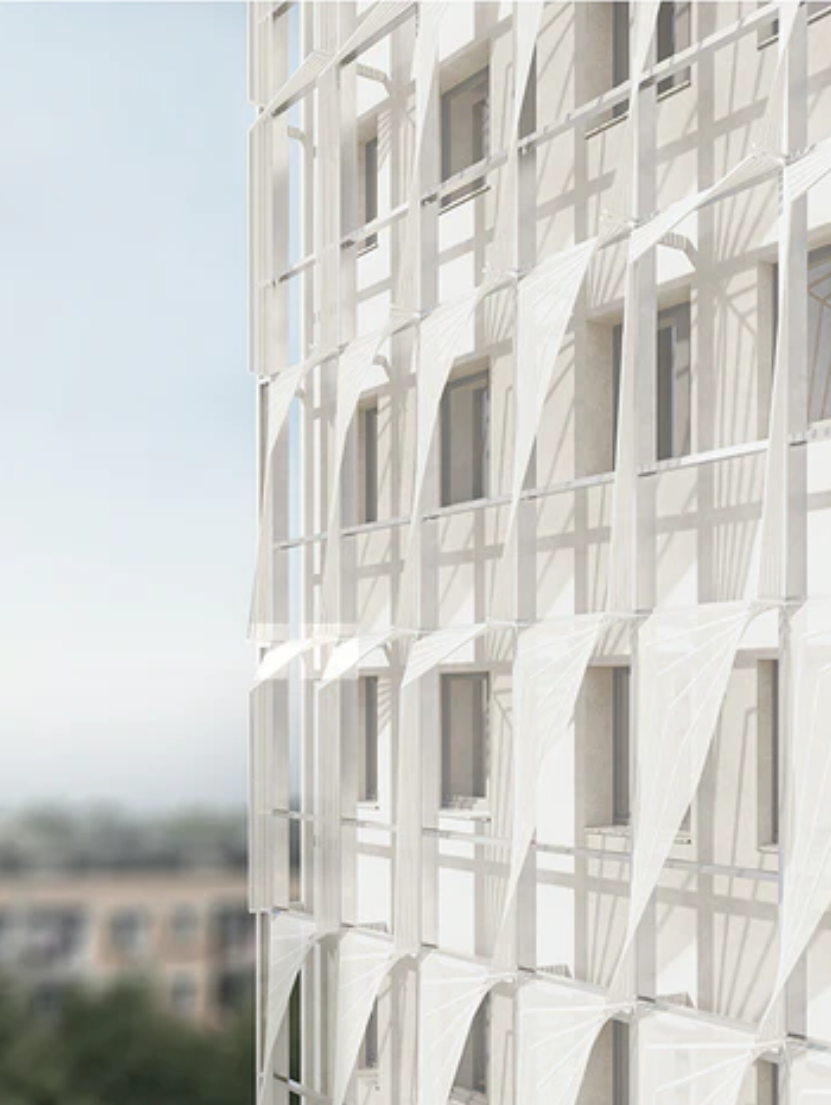
Celosia Typology in Merida, Mexico Recognition of the celosia block, commonly known as a breeze block, informed the prototype’s block-based modules. This typology presented an opportunity for the design to integrate seamlessly with an existing, widely used building form in Merida. Drawing influence, my prototype explores openings that balance material efficiency with ventilation utilizing daylight for passive evaporative cooling. Heat and daylight are inherently linked, and the design of the ’Cooling Celosia’ form responds to both. Its geometry is shaped to receive, filter, and cast light, producing shifting patterns of shadow across its surface. When arranged on a screen, the blocks form a perforated surface that offers a tactile, sensual spatial experience, whilst also providing a cooling relief. Site Specific Investigation & Collaboration The investigation and fabrication were carried out during a five-week fieldwork period. Spending an extended period in Mérida allowed me to explore the city and observe the tradition of celosias. the everyday use of building materials, and the local construction methods. I experienced the heat at different times of day and observed how various materials absorbed and released heat in distinct ways.
During my fieldwork, I met Luis Echeverría, an archaeologist and ceramic artist based in the town of Ticul, south of Mérida. Luis specialises in the reconstruction of ancient Maya ceramic techniques and introduced me to traditional ceramic practices still used in the region today. Under his guidance, I spent two and a half weeks working in his studio, producing 15 terracotta bricks from reclaimed local clay using a press-moulding method (3-part plaster mould). Working with Luis was an exercise of knowledge sharing, and the passing on of techniques, through this exchange, making became a shared language shaped by observation, repetition and the transfer of embodied skill. Each form has its own individual handmade character, unique textures and subtle variations that emerge through a slow handcrafted process. This brings together an ancient craft with the innovative idea of celosias as vessels, employing daylight for evaporative cooling. Once fired, the bricks were transported back to Mérida for testing. To evaluate the cooling performance of the ceramic blocks, I conducted a controlled water-absorption and evaporation test focused on surface-temperature changes over time.
Results and Reflection The investigation collected two datasets. The first compared submerged solid terracotta blocks with water-filled voided blocks, measuring temperature changes over two hours using a thermal heat gun. Both types cooled through evaporation, with solid blocks showing an average reduction of 2.6 °C and voided blocks achieving a greater 4.40 °C decrease. The voided blocks consistently performed better, retaining water longer and maintaining lower surface temperatures. The second dataset, recorded using a FLIR thermal camera, compared a screen of 12 voided blocks placed in front of a concrete masonry wall rendered in plaster. The voided blocks measured 21.4 °C, 6.9 °C cooler than the wall behind. Both results support the hypothesis, demonstrating the potential of voided ceramic forms for passive cooling. By harnessing daylight, these modular vessels enhance evaporative cooling and offer a strategy for passive thermal regulation in Mérida’s warming urban environment.