2026 - Sun the Quilt
Category
Region 4: Asia and Oceania
Students
Qicheng Xu, Rui Gao, Xuanyi Zhang, Kunhong Cai, Luo Jun, & Ruan Guoqiang
Teacher
Qingsong Han
School
Xi'an University of Architecture and Technology
Country
China
Download
Project ↓
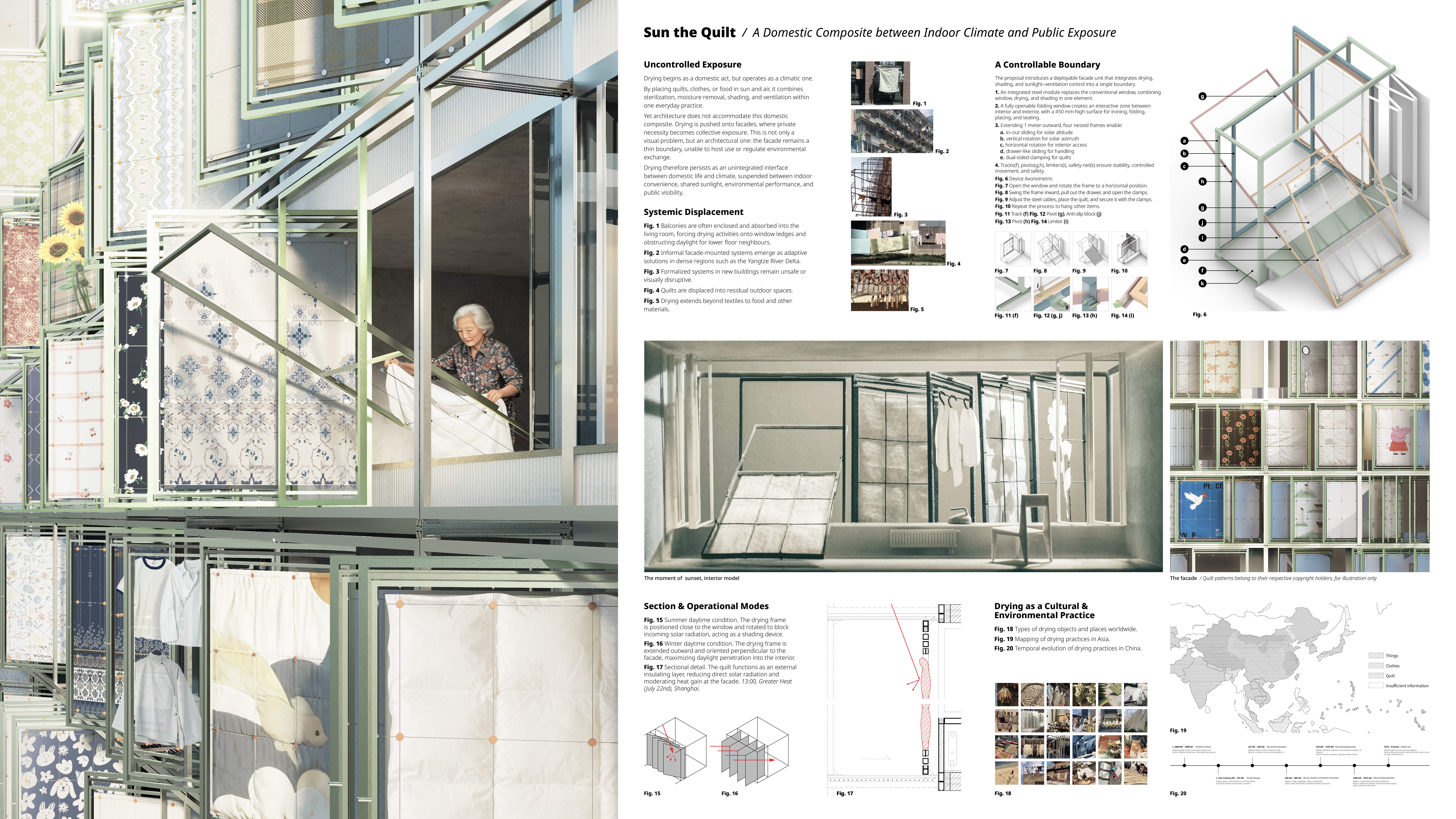
Sun the Quilt A Domestic Composite between Indoor Climate and Public Exposure Uncontrolled Exposure Drying begins as a domestic act, but operates as a climatic one. By placing quilts, clothes, or food in sun and air, it combines sterilization, moisture removal, shading, and ventilation within one everyday practice. Yet architecture does not accommodate this domestic composite. Drying is pushed onto facades, where private necessity becomes collective exposure. This is not only a visual problem, but an architectural one: the facade remains a thin boundary, unable to host use or regulate environmental exchange. Drying therefore persists as an unintegrated interface between domestic life and climate, suspended between indoor convenience, shared sunlight, environmental performance, and public visibility.
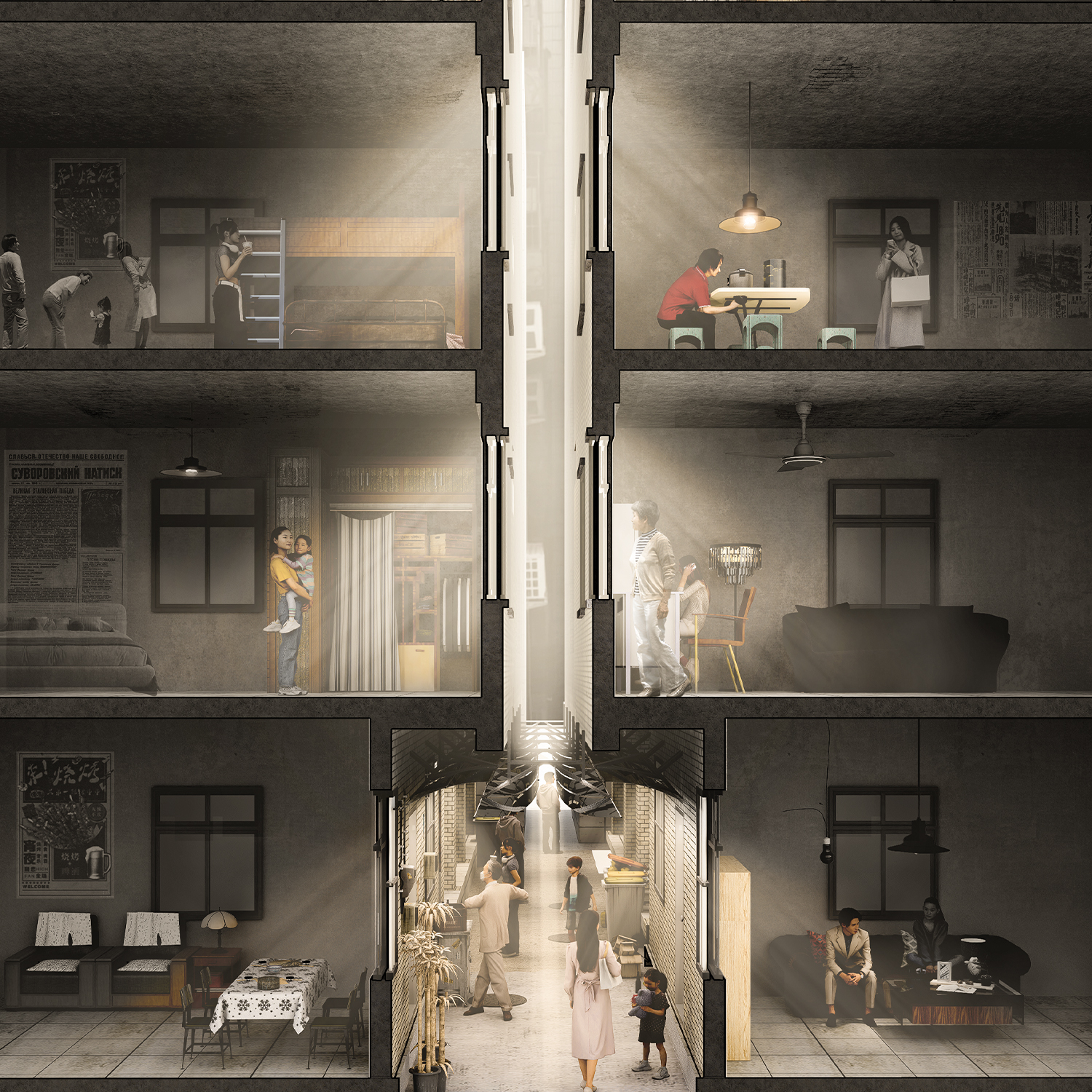
Systemic Displacement Balconies are often enclosed and absorbed into the living room, forcing drying activities onto window ledges and obstructing daylight for lower floor neighbours. Informal facade-mounted systems emerge as adaptive solutions in dense regions such as the Yangtze River Delta. Formalized systems in new buildings remain unsafe or visually disruptive. Quilts are displaced into residual outdoor spaces. Drying extends beyond textiles to food and other materials. A Controllable Boundary.
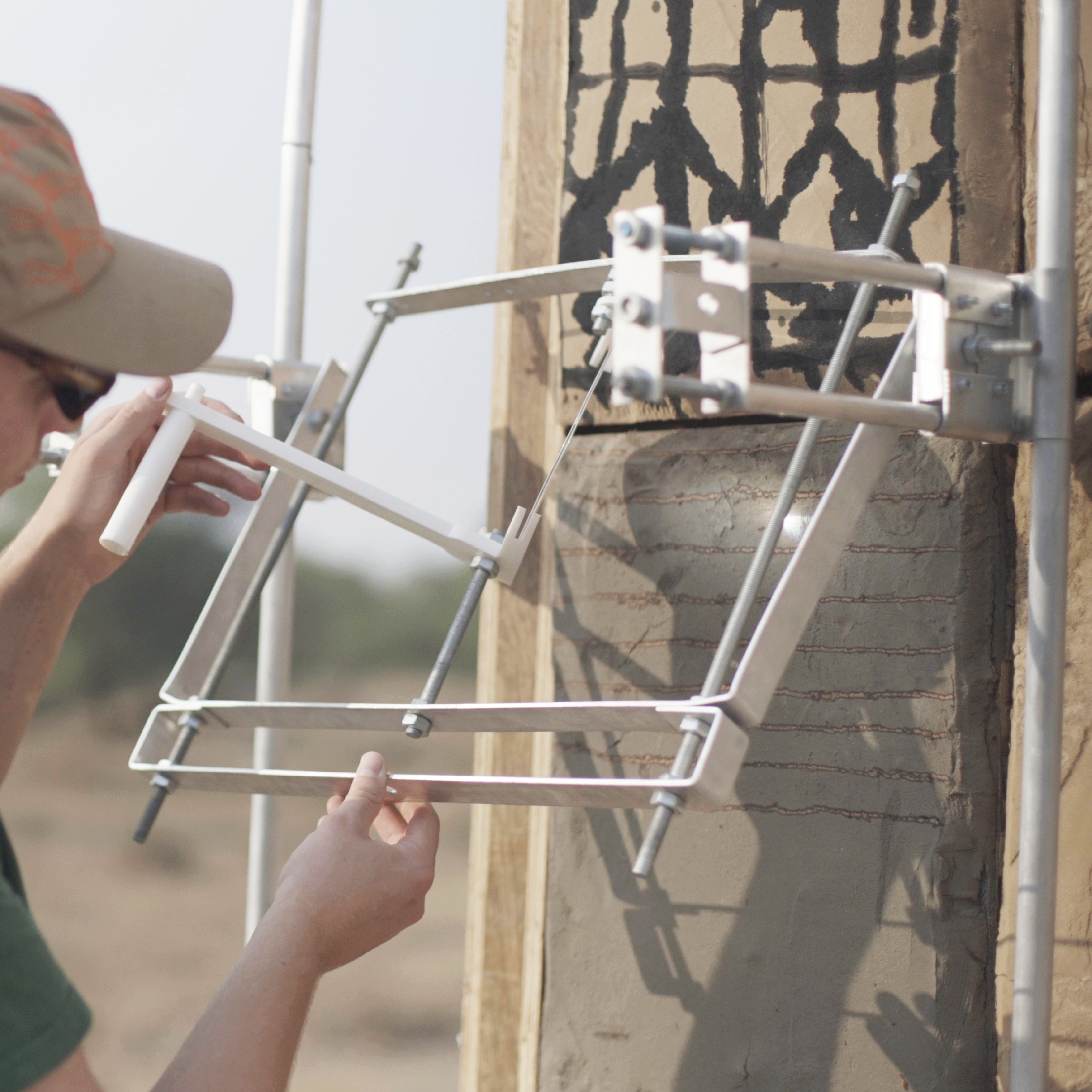
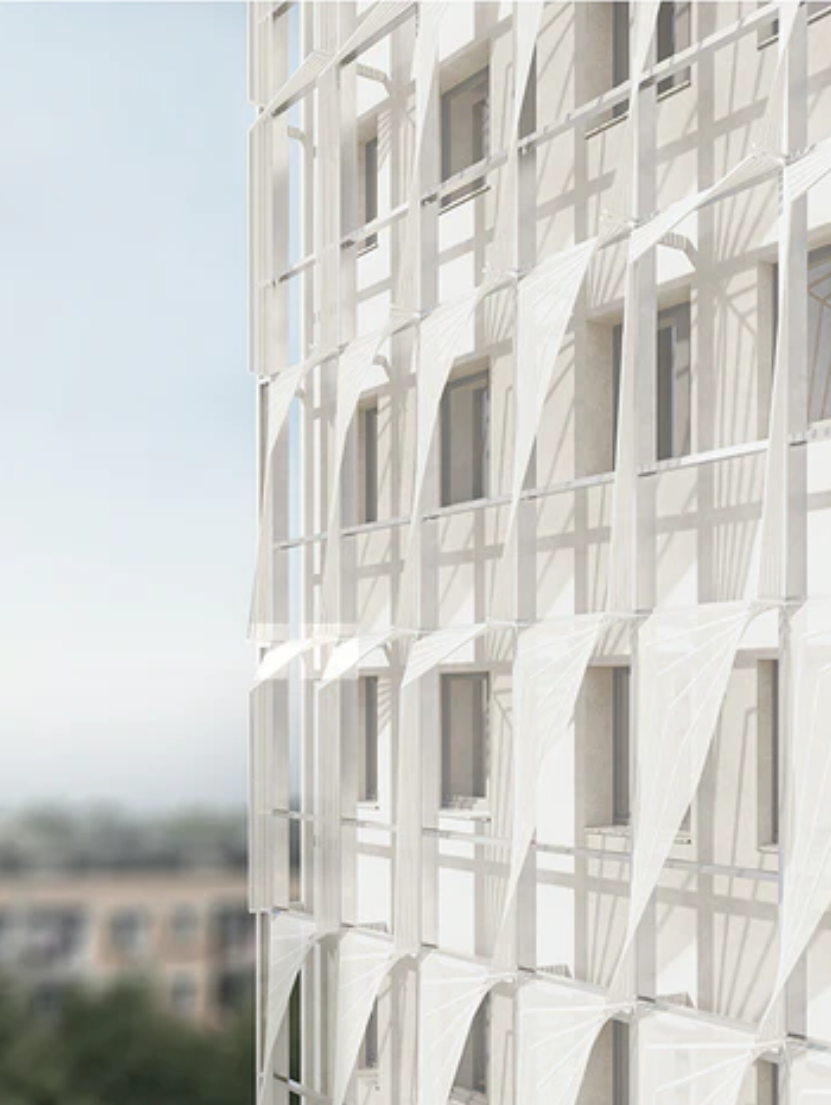
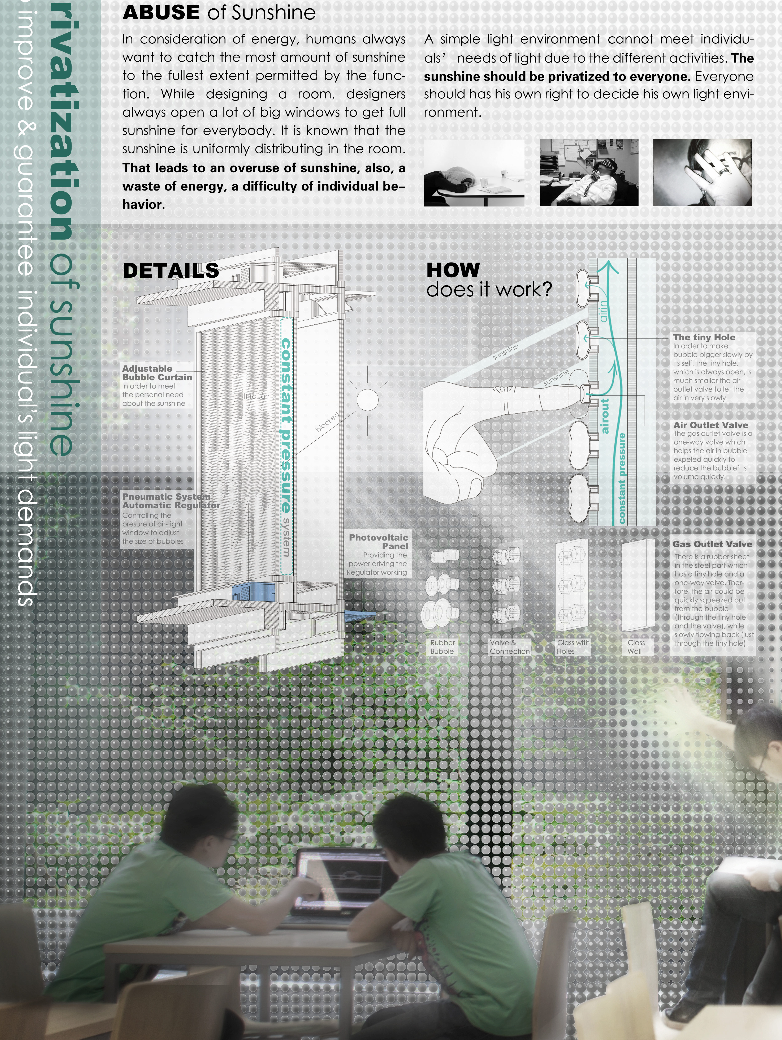
The proposal introduces a deployable facade unit that integrates drying, shading, and sunlight–ventilation control into a single boundary. 1. An integrated steel module replaces the conventional window, combining window, drying, and shading in one element. 2. A fully openable folding window creates an interactive zone between interior and exterior, with a 450 mm-high surface for ironing, folding, placing, and seating.3. Extending 1 meter outward, four nested frames enable: a. in–out sliding for solar altitude b. vertical rotation for solar azimuth c. horizontal rotation for interior access d. drawer-like sliding for handling e. dual-sided clamping for quilts4. Tracks, pivots, limiters, safety net ensure stability, controlled movement, and safety. How to use Open the window and rotate the frame to a horizontal position. Swing the frame inward, pull out the drawer, and open the clamps. Adjust the steel cables, place the quilt, and secure it with the clamps.
Repeat the process to hang other items. Section & Operational Modes Summer daytime condition: The drying frame is positioned close to the window and rotated to block incoming solar radiation, acting as a shading device. Winter daytime condition: The drying frame is extended outward and oriented perpendicular to the facade, maximizing daylight penetration into the interior. The quilt functions as an external insulating layer, reducing direct solar radiation and moderating heat gain at the facade. 13:00, Greater Heat (July 22nd), Shanghai. Drying as a Cultural & Environmental Practice Research of types of drying objects and places: Objects: textiles, bedding, food, and other domestic materials. Places: courtyard, rooftop, engawa space, plaza, country road.